THE ENFORCEMENT POINT
Decide before it executes.
An enforcement point in front of your agents. Every call to a model, a tool or another agent is decided before it reaches its destination, with the principal behind it verified against your own identity provider.
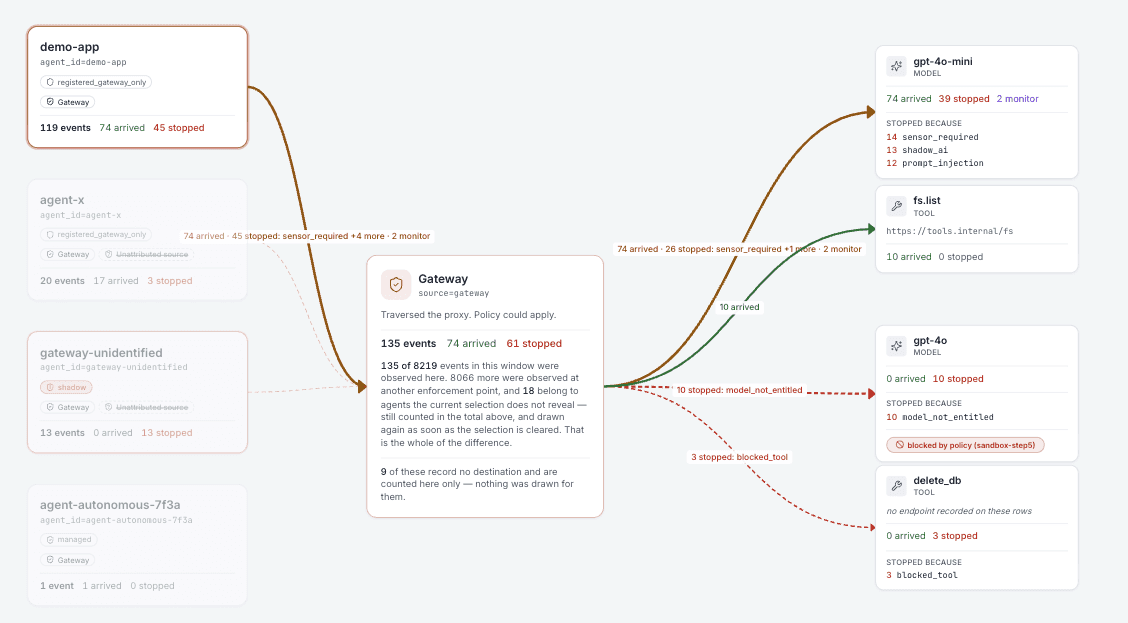
COVERAGE WITHOUT INSTRUMENTATION
Coverage without instrumentation
The sensor gives depth inside code you control. The gateway gives breadth across everything you do not: legacy agents, third party agents, workloads nobody registered. Both call the same detection engine and enforce the same verdict, so coverage reads as one picture rather than two consoles.
SENSOR
Depth inside the agents you control.
GATEWAY
Breadth across every call you need to govern.
VALIDATED LOCALLY
Signature. Issuer. Expiry. Audience.
IDENTITY, NOT ANOTHER IDENTITY SYSTEM
Your identity provider stays yours
We consume identity rather than issuing it. Tokens are validated offline against your provider’s published signing keys, with signature, issuer, expiry and audience checked on every request. No callback into your identity plane. If a team has no provider for its agents we can supply one, but most will not need it.
VERIFIED DELEGATION
Who is really acting
Users rarely call agents directly. Applications do, and agents call other agents. We verify the principal behind every call using standards-based on-behalf-of token exchange rather than credential forwarding, so a token captured at one hop cannot be replayed at the next. Each hop records a verified subject and acting client, and the full chain from person to application to agent to tool is reconstructed even though no single token carries that history.
CONTROL THAT DOES NOT WAIT
Denied on the next request.
A principal whose standing collapses is denied on the next request, through every agent, regardless of whether their token is still valid.
WHAT IT COSTS
What it costs
Measured on AWS g5.xlarge with the full stack in one environment: the gateway adds 4.4ms at the median and 8.4ms at the 95th percentile on clean traffic. Escalation to the guard model, which happens only when the fast path is genuinely ambiguous, costs a few hundred milliseconds. Measured by paired sampling against real traffic, not estimated.
4.4ms median
8.4ms at the 95th percentile
STANDARDS ON EVERY EDGE
Standards on every edge
OIDC to any identity provider. The Envoy external authorization protocol to any compatible gateway, so it works with Istio, Envoy Gateway, Gloo or Google Cloud Service Extensions without a Delphi proxy in the path. A plain HTTP interface to everything else. Everything runs inside your perimeter.
OIDC · Your identity provider
Envoy ext_authz · Compatible gateways
HTTP · Everything else